Why This Comparison Matters
Silicone oil is not a single product. The two most common families — dimethyl silicone oil (PDMS) and methyl phenyl silicone oil — look similar but behave very differently under heat, cold, and light. Choosing the wrong one means either overspending on performance you don't need, or failing in conditions your application demands.
This guide compares the two across 10 parameters that matter to engineers, procurement managers, and formulators — with real-world application recommendations from Moon Technology's production line.
Quick-Reference Comparison Table
| Parameter | Dimethyl Silicone Oil (PDMS) | Methyl Phenyl Silicone Oil |
|---|---|---|
| Chemical Name | Polydimethylsiloxane | Methyl Phenyl Silicone Oil |
| CAS Number | 63148-62-9 | 63148-58-3 (varies by phenyl content) |
| Molecular Groups | All methyl (–CH₃) on Si | Methyl (–CH₃) + phenyl (–C₆H₅) on Si |
| Viscosity Range | 100 – 10,000 cSt (standard grades) | 10 – 1,000 mm²/s (customizable) |
| Max Continuous Temp | 200°C Good | 300°C (peak 320°C) Superior |
| Low-Temp Pour Point | −50°C Good | −50°C to −20°C (wider range) Situational |
| Refractive Index | 1.400 – 1.405 | 1.410 – 1.550 Tunable |
| Density (25°C) | 0.930 – 0.975 g/cm³ | 0.990 – 1.100 g/cm³ |
| Flash Point | >200°C | >280°C Safer |
| Relative Price | Baseline (1×) Economical | 2 – 4× higher |
When to Choose Dimethyl Silicone Oil (PDMS)
PDMS is the workhorse of the silicone world. With all-methyl groups on the silicon backbone, it delivers excellent stability, water repellency, and lubrication at a price point that makes it the default choice for most applications.
Choose PDMS When You Need:
General-purpose lubrication · Mold release · Textile soft finishing · Cosmetic formulations · Antifoaming · Dielectric fluid · Cost-sensitive projects
PDMS Strengths
- Cost-effective: The most economical silicone oil, produced at industrial scale since the 1950s.
- Wide viscosity range: Available from 100 cSt (thin, fast-spreading) to 10,000 cSt (thick, cushioning), covering most industrial needs.
- FDA & REACH compliant: Food-grade and cosmetic-grade PDMS is approved for direct contact applications.
- Excellent dielectric properties: High dielectric strength makes it ideal for transformer and electrical insulation fluids.
- Low surface tension: 20–21 mN/m — superior spreading and wetting compared to organic oils.
PDMS Limitations
- Thermal ceiling at 200°C: Above this, methyl groups oxidize and the oil gels or discolors.
- Refractive index capped at ~1.405: Not suitable for high-refractive-index optical applications.
- Not radiation-resistant: Phenyl groups absorb UV and gamma radiation far better; PDMS degrades under prolonged exposure.
When to Choose Methyl Phenyl Silicone Oil
Methyl phenyl silicone oil replaces some methyl groups with bulkier phenyl groups on the silicon chain. This structural change unlocks higher thermal stability, better low-temperature performance, and a tunable refractive index — at a premium price.
Choose Methyl Phenyl When You Need:
Heat transfer above 200°C · LED/optical encapsulation · Low-temperature lubrication in arctic conditions · High-refractive-index coupling · Radiation-resistant fluids
Methyl Phenyl Strengths
- 300°C continuous thermal stability (peak 320°C): The phenyl ring absorbs heat energy that would break methyl bonds, extending usable range by 50%+.
- Tunable refractive index (1.410–1.550): Higher phenyl content raises refractive index — critical for LED encapsulation and optical coupling where light transmission efficiency matters.
- Wider low-temperature range: Phenyl groups disrupt crystallization, maintaining fluidity and flexibility in extreme cold better than high-viscosity PDMS.
- Higher flash point (>280°C): Safer to handle and store in high-temperature processing environments.
- Radiation resistance: Phenyl groups act as UV absorbers, making it suitable for outdoor and radiation-exposed applications.
Methyl Phenyl Limitations
- 2–4× more expensive than PDMS due to phenyl raw material costs and more complex synthesis.
- Higher density (up to 1.100 g/cm³): In weight-sensitive applications, this adds up.
- Limited viscosity grades off-the-shelf; many grades require custom production with longer lead times.
- Not FDA-approved for food contact in all grades; certification must be verified per batch.
Application-by-Application: Which Oil Wins?
📝 Textile Soft Finishing
PDMS (350–1000 cSt) provides the soft hand feel and hydrophobic surface that textile finishers need. Methyl phenyl is overkill — its thermal and optical advantages don't matter on fabric.
🧴 Cosmetic & Personal Care
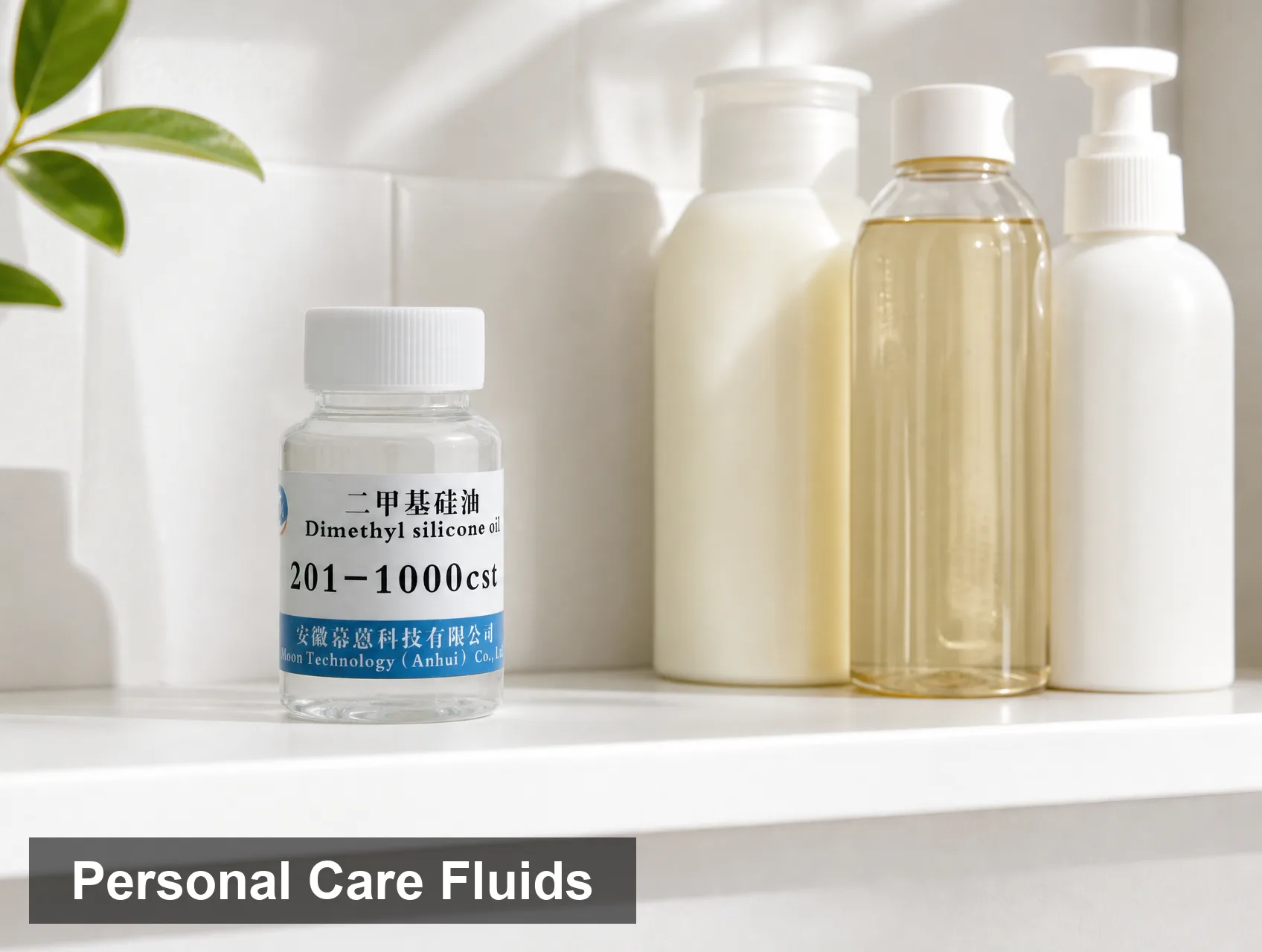
Low-viscosity PDMS (100–350 cSt) is the backbone of skincare and haircare formulations — non-greasy feel, fast spreading, FDA-cleared. Methyl phenyl is not used here.
💡 LED & Optical Encapsulation
Refractive index above 1.50 is needed to match LED chip materials. High-phenyl-content methyl phenyl silicone oil achieves this — PDMS (1.405) would scatter light and reduce output.
🌡️ Heat Transfer Fluid (200–300°C)
Continuous operation above 200°C is beyond PDMS. Methyl phenyl silicone oil is the standard for high-temperature bath fluids, heat transfer systems, and thermal processing.
⚡ Transformer Insulation
PDMS offers excellent dielectric strength, moisture resistance, and thermal stability up to 200°C — well within transformer operating range. Cost advantage makes it the industry standard.
❄️ Low-Temperature Lubrication
PDMS handles −50°C and is sufficient for most cold-climate gear. For extreme arctic conditions (below −50°C or wide thermal cycling), low-phenyl methyl phenyl oil provides extra flexibility.
🔇 Antifoaming Agent
PDMS low surface tension (20 mN/m) makes it the universal defoamer in chemical processing, food production, and wastewater treatment. Methyl phenyl is not needed here.
☀️ Solar PV & Thermal Management
Solar panel potting and thermal interface materials benefit from methyl phenyl's UV resistance and thermal stability — outdoor durability is superior to PDMS.
🧪 Laboratory Bath Fluid
For standard lab thermostatic baths (up to 200°C), PDMS is the economical choice. For high-temp baths (200–300°C), switch to methyl phenyl.
Technical Specifications Side-by-Side
| Property | PDMS (Dimethyl) | Methyl Phenyl (M-556) |
|---|---|---|
| CAS Number | 63148-62-9 | 63148-58-3 |
| Molecular Formula | (C₂H₆OSi)ₙ | (C₂H₆OSi)ₙ(C₈H₁₀OSi)ₘ |
| Appearance | Colorless transparent viscous liquid | Colorless to pale yellow viscous liquid |
| Purity | ≥99% | ≥98% (customizable) |
| Viscosity Range | 100, 350, 1000, 5000, 10000 cSt | 10–1,000 mm²/s (customizable) |
| Density (25°C) | 0.930–0.975 g/cm³ | 0.990–1.100 g/cm³ |
| Refractive Index (25°C) | 1.400–1.405 | 1.410–1.550 (↑ with phenyl content) |
| Flash Point | >200°C | >280°C |
| Thermal Stability | −50°C to 200°C (continuous) | −50°C to 300°C (peak 320°C) |
| Certifications | REACH, FDA (food/cosmetic grade) | REACH (food grade per batch) |
| Packing | 200 kg drums, 1000 kg IBC | 50 kg / 200 kg drums, 1000 kg IBC |
Cost-Benefit Analysis
The price gap between PDMS and methyl phenyl silicone oil is significant — but so is the performance gap. Here's how to think about it:
- If your application stays below 200°C: Use PDMS. There is no technical reason to pay 2–4× more for methyl phenyl.
- If you need refractive index above 1.41: You have no choice — methyl phenyl is the only option. PDMS physically cannot reach higher RI.
- If thermal cycling is extreme (−60°C to +300°C): Methyl phenyl's wider operating range prevents both cold-temperature crystallization and high-temperature degradation.
- If UV/radiation exposure is continuous: Methyl phenyl's phenyl rings absorb radiation that would destroy PDMS within months.
The practical rule: start with PDMS. Only switch to methyl phenyl when a specific requirement (temperature, optics, radiation) forces the upgrade.
Need Help Choosing the Right Silicone Oil?
Our technical team helps you select the right grade, viscosity, and phenyl content for your application. Free 1 kg sample, TDS, and quotation within 24 hours.
Get Quote & Free Sample →Frequently Asked Questions
What is the main difference between dimethyl silicone oil and methyl phenyl silicone oil?
The main difference is the molecular structure. Dimethyl silicone oil (PDMS) has only methyl groups attached to silicon, offering excellent general-purpose performance at low cost. Methyl phenyl silicone oil replaces some methyl groups with phenyl groups, which improves thermal stability (up to 300°C vs 200°C), low-temperature flexibility, and refractive index (up to 1.550 vs 1.405), but at a higher price.
Which silicone oil is better for high-temperature applications above 200°C?
Methyl phenyl silicone oil is the clear choice for continuous operation above 200°C. It withstands up to 300°C continuously (with peak tolerance to 320°C), while dimethyl silicone oil (PDMS) is rated for continuous use up to 200°C. Applications like heat transfer fluids, high-temperature lubrication, and thermal processing require methyl phenyl silicone oil.
Can I use dimethyl silicone oil for optical applications?
Dimethyl silicone oil has a refractive index of 1.400-1.405, which is suitable for general-purpose applications but not ideal for high-clarity optical uses. Methyl phenyl silicone oil offers a refractive index range of 1.410-1.550 that increases with phenyl content, making it the better choice for LED encapsulation, optical coupling, and lens systems where higher refractive index improves light transmission.
Is methyl phenyl silicone oil more expensive than dimethyl silicone oil?
Yes, methyl phenyl silicone oil is typically 2-4 times more expensive than dimethyl silicone oil due to the cost of phenyl-containing raw materials and more complex synthesis. For applications that do not require high-temperature stability or high refractive index, dimethyl silicone oil provides better cost-effectiveness.
Which silicone oil should I choose for cold climate applications?
Both oils perform well at low temperatures, but methyl phenyl silicone oil offers a wider pour point range (-50°C to -20°C depending on phenyl content) and maintains better flexibility in extreme cold. For applications in arctic or sub-zero environments, low-phenyl-content methyl phenyl silicone oil is preferred. For moderate cold above -50°C, dimethyl silicone oil is sufficient and more economical.
Does Moon Technology supply both types of silicone oil?
Yes. Anhui Moon Technology Co., Ltd. manufactures both dimethyl silicone oil (PDMS, CAS 63148-62-9) in viscosities from 100 to 10,000 cSt, and methyl phenyl silicone oil (Grade M-556, phenyl content 5-50% customizable). Free 1 kg samples are available; MOQ and pricing vary by grade. Contact echo@ahmoontech.com for TDS and quotation.
Compare the Grades
Where to go next from here.