Quick answer: match the functional group to your resin
All three silanes share the same working principle: the alkoxy groups hydrolyse to silanol and chemically bond to inorganic surfaces (glass, silica, metal oxides, mineral fillers), while the single organic functional group on the other end reacts into the surrounding polymer. So the selection question is never "which silane is better" — it is "which functional group reacts with my resin system?"
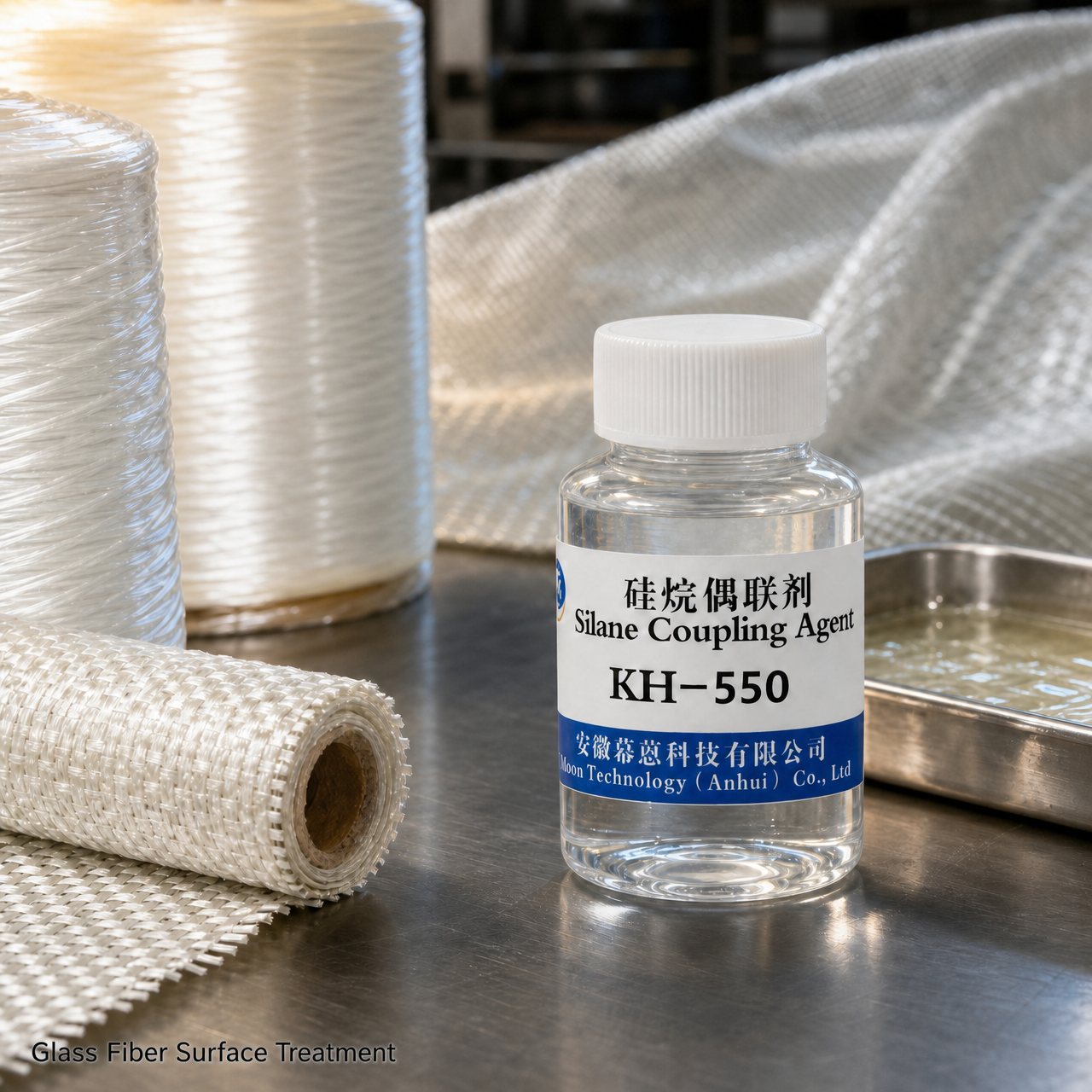
- KH-550 (amino) → epoxy, phenolic, polyurethane, melamine, nylon. The amine also catalyses some cures.
- KH-560 (epoxy) → epoxy, PU, acrylic systems where wet adhesion and corrosion resistance matter most.
- KH-570 (methacryloxy) → unsaturated polyester, vinyl ester, acrylics — anything that free-radically copolymerises.
Side-by-side comparison table
| Property | KH-550 | KH-560 | KH-570 |
|---|---|---|---|
| Chemical name | 3-Aminopropyltriethoxysilane | 3-Glycidoxypropyltrimethoxysilane | 3-Methacryloxypropyltrimethoxysilane |
| CAS No. | 919-30-2 | 2530-83-8 | 2530-85-2 |
| Functional group | Primary amine (–NH₂) | Epoxy ring | Methacrylate C=C |
| Reactivity mechanism | Covalent with epoxy/phenolic/PU; catalytic for amine cure | Opens epoxy ring during cure | Free-radical copolymerisation |
| Best resin systems | Epoxy, phenolic, PU, melamine, PA | Epoxy, PU, acrylic, polysulfide | UPE, vinyl ester, acrylic, EVA |
| Weak fit | Unsaturated polyester (amine can inhibit cure) | Free-radical systems | Strongly basic/acidic aqueous systems |
| Typical dosage | 0.3–1.5% of filler; 0.5–2% of formulation | 0.5–1.5% of filler | 0.5–2% of resin or filler |
| Hydrolysis pH (water primer) | No pre-hydrolysis needed (self-catalysing) | pH 4–5 with acetic acid | pH 4–5, use within hours |
| Special note | Also acts as adhesion promoter in RTV-1 sealants and polyamide blends | Best wet adhesion & corrosion damping in epoxy coatings | Standard in fibreglass (FRP) and artificial stone |
KH-550: the amino workhorse
KH-550 (A-1100 equivalent) is the most universally reactive of the three. The primary amine attacks epoxy rings, links with isocyanates and formaldehyde resins, and even hydrogen-bonds strongly to polyamide and PVC. Two practical consequences:
- In glass-fibre sizing for epoxy and phenolic composites, KH-550 remains the default choice — it gives a tough, water-resistant interphase.
- In mineral-filled thermoplastics (talc, wollastonite, kaolin in PA/PP), 0.5% KH-550 on the filler noticeably raises tensile strength and reduces melt viscosity.
Caution: in unsaturated polyester systems, residual amine can retard peroxide cure — that is KH-570 territory, not KH-550.
KH-560: the epoxy adhesion specialist
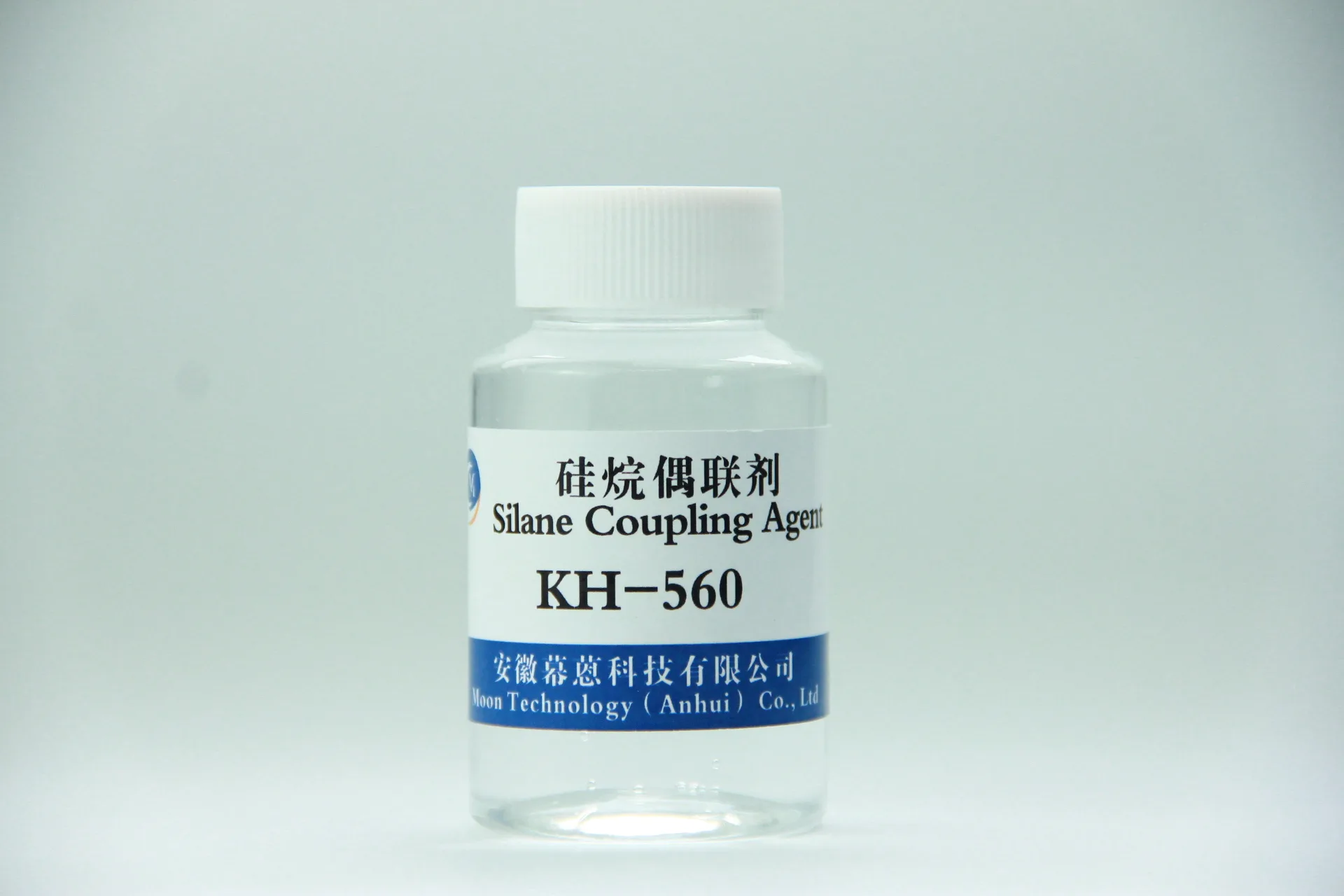
KH-560 (A-187 equivalent) carries a glycidoxy epoxy ring, so it disappears chemically into an epoxy or PU network during cure. Its strength is wet adhesion: coatings and adhesives formulated with 0.5–1% KH-560 keep bond strength after boiling-water and salt-spray exposure far better than unmodified systems. Typical uses: two-pack epoxy coatings on metal, PU sealants, acrylic emulsions on glass, and electronics encapsulation where corrosion creep matters.
KH-570: the free-radical partner
KH-570 (A-174 equivalent, KH-570 silane methacryloxy) is built for peroxide- and UV-cured systems. The methacrylate double bond copolymerises into unsaturated polyester, vinyl ester and acrylic matrices — this is why it is the standard coupling agent in FRP fibreglass products, artificial quartz stone, gelcoats and acrylic sheet. It also crosslinks PE in combination with peroxide for cable insulation. Dosage is usually 0.5–2% on resin solids.
Decision guide: which one for your case?
| Your application | Recommended grade |
|---|---|
| Glass fibre sizing for epoxy laminates | KH-550 (or KH-560 for max wet adhesion) |
| FRP / artificial stone / gelcoat (UPE resin) | KH-570 |
| Epoxy or PU coating on metal, glass, concrete | KH-560 |
| RTV silicone sealant adhesion promoter | KH-550 |
| Mineral-filled polyamide / PP compounds | KH-550 (talc, wollastonite) / KH-570 (in peroxide-cured systems) |
| Acrylic emulsion paints on mineral substrates | KH-560 (epoxy) or KH-570 (copolymerises with acrylic binder) |
| Abrasive wheels, grinding tools (phenolic) | KH-550 |
| Cable crosslinked PE | KH-570 with peroxide (or vinyl silane A-171) |
Can you combine grades?
Yes — blending is common and often outperforms single grades. The classic combination is KH-570 + KH-550 in glass sizing for UPE: KH-570 copolymerises into the resin, while 10–30% KH-550 improves fibre wet-out. In epoxy systems, KH-550 + KH-560 blends improve both initial bond and hot-wet durability. Keep total silane within the usual 0.5–2% band and trial before scaling.
Frequently asked questions
What is the difference between KH-550, KH-560 and KH-570?
The functional group. KH-550 is amino (–NH₂) and reacts with epoxy, phenolic, PU and nylon systems; KH-560 is epoxy-functional and maximises wet adhesion in coatings and adhesives; KH-570 is methacryloxy-functional and copolymerises with unsaturated polyester, vinyl ester and acrylics. The inorganic (alkoxy-silicon) end is essentially the same in all three.
Can I mix KH-550 and KH-570 together?
Yes. A 1:1 to 3:1 (KH-570:KH-550) blend is a proven sizing recipe for fibreglass used with unsaturated polyester. Trial first — too much amine can shorten pot life.
Which silane for glass fibre sizing?
KH-550 for epoxy/phenolic composites; KH-570 when the resin is unsaturated polyester or vinyl ester; KH-560 when wet adhesion and corrosion resistance are the priority.
Are KH-570 and A-171 the same?
No. KH-570 is the longer methacryloxypropyl silane (CAS 2530-85-2); A-171 is vinyltrimethoxysilane (CAS 2768-02-7). Both copolymerise with unsaturated systems, but KH-570 gives tougher interphases and better glass adhesion.
What dosage should I use?
Typical: KH-550 at 0.3–1.5% of filler, KH-560 at 0.5–1.5%, KH-570 at 0.5–2%. Optimum is system-specific — run a trial batch. All three grades are available from MOON Tech with TDS, MSDS and free 1 kg samples.