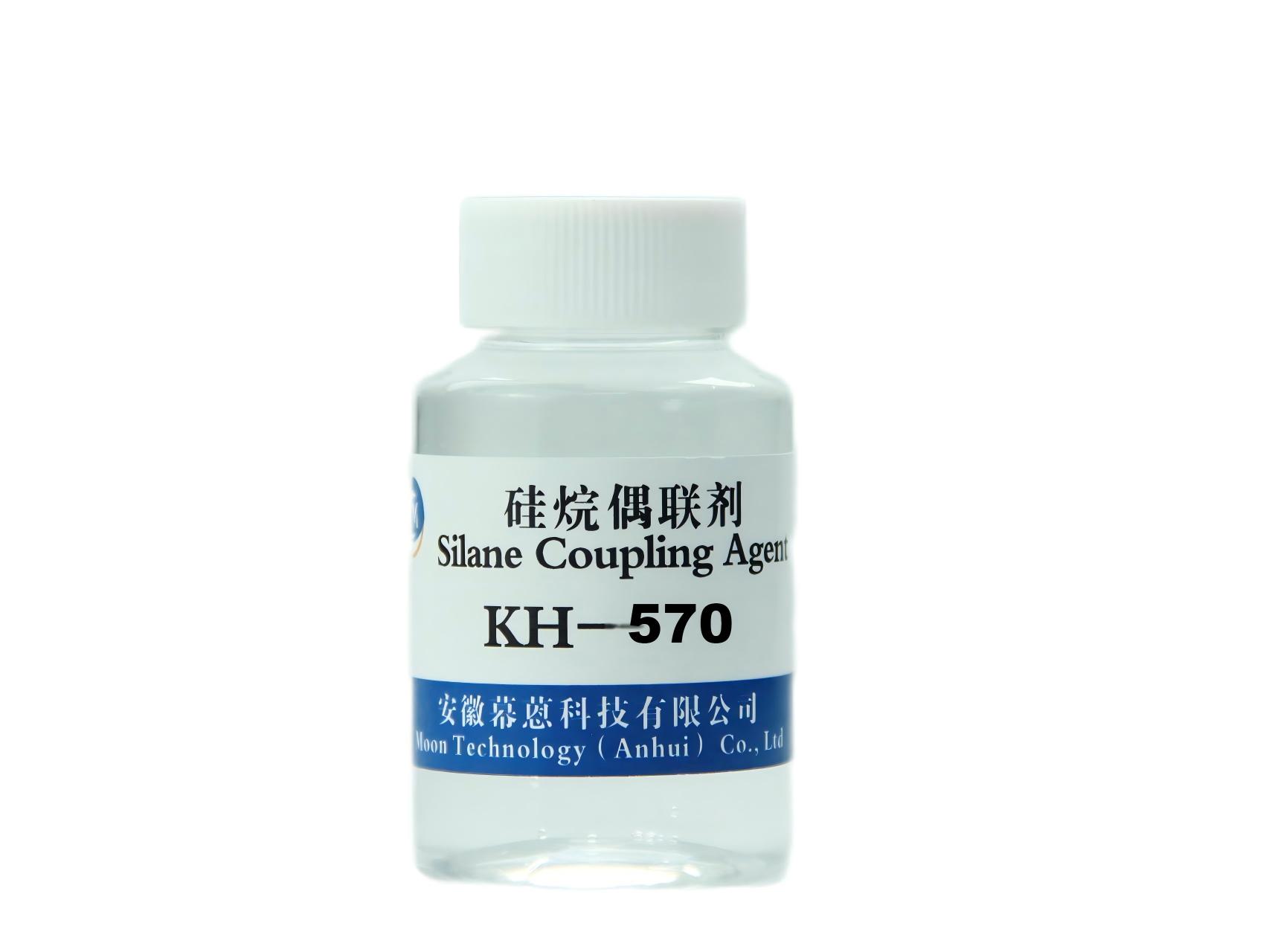
What KH-570 Is and How It Works
MOON-KH570 is 3-methacryloxypropyltrimethoxysilane — a methacryloxy-functional silane coupling agent with the CAS number 2530-85-0. Like other silanes it has two chemically distinct ends, but its second end behaves differently from amino or epoxy silanes:
- A tri-methoxy silane end that hydrolyses in the presence of water to produce silanol groups (Si–OH), which condense with hydroxyl groups on inorganic surfaces (glass, metal oxides, silica, mineral fillers) to form stable Si–O–Si or Si–O–M covalent bonds.
- A methacrylate (acrylate) end carrying a polymerizable C=C double bond. Instead of reacting with a curing agent, this double bond participates directly in the free-radical polymerization of acrylic, methacrylic, vinyl ester and UV-cured resin systems — becoming chemically part of the polymer network as it cures.
The result is a continuous chemical bridge at the interface — but unlike KH-550 or KH-560, KH-570 is designed for systems that cure by light, heat or peroxide rather than by condensation or epoxy addition. It is the standard choice for UV-curable coatings, dental composites and optical adhesives where the silane must be locked into the cured film.
Technical Specifications
| Parameter | Specification |
|---|---|
| Product Code | MOON-KH570 |
| Chemical Name | 3-Methacryloxypropyltrimethoxysilane |
| CAS No. | 2530-85-0 |
| EINECS No. | 219-785-8 |
| Molecular Formula | C₁₀H₂₀O₅Si |
| Molecular Weight | 248.35 g/mol |
| Appearance | Colourless to pale yellow transparent liquid |
| Purity | ≥99% |
| Density (25°C) | 1.040–1.050 g/cm³ |
| Refractive Index (25°C) | 1.428–1.432 |
| Boiling Point | 255°C |
| Flash Point | 108°C |
| Packaging | 200 kg iron drum · 1000 L IBC (950 kg) |
| Equivalent Grades | Dow Corning Z-6030 · GE Silquest A-174 · Shin-Etsu KBM-503 · Evonik Dynasylan MEMO Equivalent grades are given for identification only and do not imply any affiliation with the trademark owners. |
TDS and MSDS are available on request. COA is issued for every production batch.
KH-550 vs KH-560 vs KH-570: Which Silane Do You Need?
KH-550, KH-560 and KH-570 are the three most widely used silane coupling agents. All improve adhesion at the polymer–filler or polymer–substrate interface, but each targets a different resin chemistry. Choosing the right one depends on how your system cures.
| KH-550 (Amino) | KH-560 (Epoxy) | KH-570 (Methacryloxy) | |
|---|---|---|---|
| Reactive group | Primary amine (−NH₂) | Epoxy ring | Methacrylate C=C double bond |
| Bonds to resin via | Condensation / amine cure | Ring-opening with curing agents | Free-radical copolymerization |
| Best resin systems | Epoxy (amine-cured), phenolic, PA, PC, polyester | Epoxy, polyurethane, acrylic, sealants | Acrylic, methacrylic, UV-cure, vinyl ester |
| Cure type | Condensation / amine | Epoxy / anhydride | UV / light / peroxide (radical) |
| Best for | Glass fiber sizing, thermoset composites | Coatings, metal & mineral adhesion | UV coatings, dental, optical adhesives |
| Typical dosage | 0.5–1.5% (up to 2% direct) | 0.5–2% of total formulation | 0.5–2% of total formulation |
| Colour | Colourless | Colourless to pale yellow | Colourless to pale yellow |
KH-570 is often combined with KH-560 or KH-550 in hybrid systems — for example, an epoxy primer (KH-560) topped with a UV-curable clearcoat (KH-570) — to couple different layers to the same substrate.
Typical Applications
☀️ UV-Curable Coatings
The methacrylate end copolymerizes directly into UV-cured acrylate networks, improving adhesion of scratch-resistant and decorative coatings to wood, plastics and metal. Ideal for flooring, automotive and industrial clearcoats that cure by light.
🦷 Dental & Orthodontic Materials
A long-established coupling agent in dental composites, bonding agents and restorative materials — it bonds the resin matrix to silica- and glass-filled fillers. Also used in denture base resins and orthodontic adhesives for durable interfacial strength.
📱 Electronics
Added to UV-curable conformal coatings and potting compounds for printed circuit boards and electronic components. Provides optical clarity and strong adhesion to lead frames, ceramic substrates and glass.
🎨 Printing Inks
Used in UV-curable inks for packaging, labels and graphic arts, improving adhesion to plastic films, foils and metal substrates while keeping the ink film flexible and resistant to blocking.
🔩 Optical & Glass Adhesives
Preferred for clear UV-curable adhesives used in lenses, display assemblies and optical components, where the silane must remain transparent and become part of the cured bond rather than sitting at the interface.
🏗️ Glass Fiber & Composites
Applied in sizing formulations for glass fiber mats and roving used in unsaturated polyester, vinyl ester and acrylic composite laminates, improving interfacial shear strength and resin wet-out.
How to Use It
KH-570 can be incorporated in three ways depending on the formulation and process:
- Direct addition to the resin phase — add KH-570 directly to the acrylic/UV resin and stir thoroughly before cure. Suitable for solvent-free and low-water systems; the methacrylate end then copolymerizes during curing.
- Pre-hydrolysed aqueous/alkanol solution — for waterborne systems or surface treatment: dilute KH-570 in a water/ethanol mixture (1:1 to 1:3 ratio), adjust to pH 4–5 with acetic acid, stir for 15–30 minutes to allow hydrolysis, then add to the formulation or use to treat the substrate.
- Filler pre-treatment — dilute KH-570 in ethanol or acetone (1–5% solution), spray onto mineral fillers, pigments or glass fiber, mix thoroughly and dry at 80–100°C before incorporating into the resin.
Typical dosage is 0.5–2% by weight of the total formulation, or 0.5–1.5% by weight of filler. Because the optimum level depends on filler surface area and resin type, we recommend a trial batch with three dosage points (0.5%, 1%, 2%) to establish the right level for your process.
Not Sure About Dosage for Your UV System?
Tell us your resin type, cure method, filler loading and substrate — we will recommend a starting dosage and supply a sample for your trials.
📩 Ask Our Technical TeamPackaging, Quality & Lead Time
- Packaging: 200 kg iron drum · 1000 L IBC (950 kg)
- Batch Testing: Assay, density and refractive index against specification above
- Documentation: TDS and MSDS supplied with every batch. COA issued per batch on request.
- MOQ: 800 kg for commercial orders; 1 kg free sample available
- Lead Time: 7–15 days for standard packaging (FOB Shanghai)
- Storage: Sealed container, away from moisture, heat and direct sunlight. Recommended temperature 5–30°C. Shelf life 12 months under proper storage.
Frequently Asked Questions
Ready to Specify KH-570 for Your UV-Cure Formulation?
Request the TDS, MSDS and a free 1 kg sample — we will confirm pricing, lead time and packaging options within 24 hours.
📩 Request TDS & Sample